

Kangaroos & Wallabies
Everything you need to care for orphaned macropod joeys
Keep the joey warm, dark, and quiet in a cloth pouch. Do not attempt to feed a cold animal. Contact your nearest wildlife rescue organisation or veterinarian immediately.
Quick Reference
Marsupial milk changes significantly as a joey grows. In the wild, a mother kangaroo or wallaby naturally adjusts the protein, fat, and carbohydrate content of her milk to match her joey's stage of development. Biolac formulas mirror these changes with three stages that progress your joey from early care through to independence.
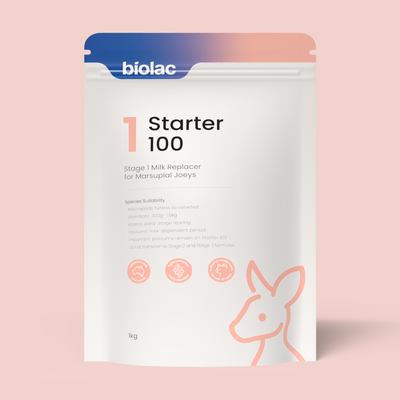
Starter 100 (M100)
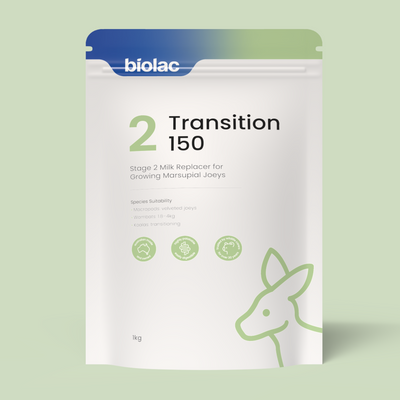
Transition 150 (M150)
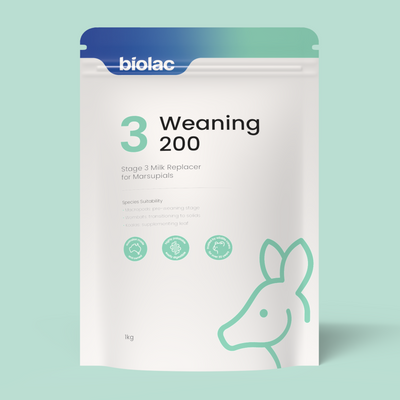
Weaning 200 (M200)
Growth & Development
Macropod development follows predictable stages. Weight and physical markers — not age alone — determine when to progress formulas. Grey and Red Kangaroos develop more slowly than most wallabies.
Pinkie / Furless
Eyes closed, ears flat, skin pink and translucent. Fully pouch-dependent. Maintain stable pouch temperature of 32–34°C. Feed every 4 hours (6 feeds per day).
Velveted / Fine Fur
Fine fur begins to appear, ears becoming erect, eyes may begin to open. Joey remains in pouch but more active. Continue 6 feeds per day.
Fully Furred / Eyes Open
Dense fur established, eyes fully open, ears erect. Joey begins to emerge from the pouch for short periods. Transition to 5 feeds per day.
Pre-Weaning / Out of Pouch
Spending extended periods outside pouch. Solid, dark pellet droppings. Nibbling grass and forage. Reduce to 4 feeds per day. Ensure access to fresh grass, hay, and clean water.
Care Guide
Which Product Do I Start With?
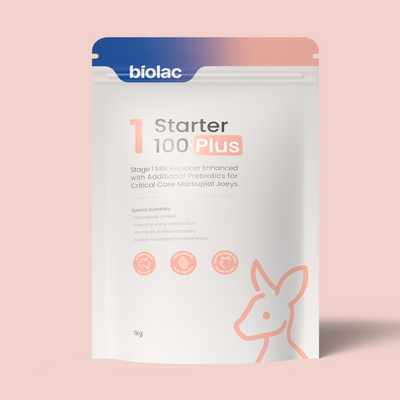
If a young joey has just come into care, begin with Biolac Starter 100 Plus. This formula contains added galacto-oligosaccharides (GOS) to support gut health and is designed for critical care and stabilisation. Keep the joey on Starter 100 Plus until it is feeding well, faecal output is consistent for its age, and it has stabilised in your care.
Older animals that are stable enough may go straight onto the appropriate formula for their stage of development.
Once stable, transition to Biolac Starter 100 for ongoing early-stage feeding. There is no need for a formal transition between Starter 100 Plus and Starter 100, as both are mixed at the same rate and have the same nutritional profile.
How to Prepare Biolac Formula
1. Weigh the required amount of powder using accurate scales (a kitchen scale reading to 0.1g is ideal for small joeys).
2. Place the powder into a clean container and add a small amount of pre-boiled warm water (not boiling). Mix into a smooth paste first to prevent lumps.
3. Add the remaining water and stir or shake well until fully dissolved.
4. Warm the prepared formula gently in a warm water bath to approximately body temperature (around 32–35°C) before feeding.
5. Test the temperature on the inside of your wrist. It should feel warm, not hot.
Important Preparation Notes
Always use pre-boiled water that has been allowed to cool. Boiling water can damage nutrients in the formula. Do not microwave prepared formula — always warm in a water bath. Shake or stir prepared formula well before each feed.
Refrigerate any unused formula and use within 24 hours. Discard after this time. Once opened, reseal the powder tightly and store in a cool, dry place. Use within 3 months.
Do not add extra water to dilute the formula unless directed by a veterinarian. Do not supplement Biolac with additional vitamins or minerals — over-supplementation (particularly vitamins A and D) can cause toxicity.
Tips for Feeding
Always feed in a calm, quiet environment. Stress can cause myopathy in macropod joeys, which can be fatal. Use an appropriately sized teat for your joey's size and species.
Hold the joey in a natural upright or slightly forward-leaning position, never on its back. Allow the joey to feed at its own pace — do not force milk into the mouth.
After feeding, gently stimulate the joey to toilet by wiping the cloacal area with a warm, damp cloth (for younger joeys). Monitor faecal consistency at every feed. Healthy faeces should be soft and formed (like thick custard) in younger joeys, progressing to firmer pellets.
Weigh your joey regularly and adjust feed volumes accordingly.
How to Transition Between Formulas
When your joey is ready for the next formula, transition gradually over 5 days. This allows the digestive system to adjust to the change in nutrient composition.
Starter 100 → Transition 150 (per 100ml prepared formula):
Day 1: 13.5g Starter 100 + 4.5g Transition 150
Day 2: 9g Starter 100 + 9g Transition 150
Day 3: 4.5g Starter 100 + 13.5g Transition 150
Day 4: 18g Transition 150 only
Day 5: Maintain 18g Transition 150 per 100ml
Transition 150 → Weaning 200: Follow the same 5-day schedule, replacing Transition 150 with Weaning 200 in the same proportions.
If diarrhoea, constipation, or bloating occurs, pause and hold at the current step. Some joeys may need several days or weeks at a particular stage before progressing. Never rush a transition.
Calculating Feed Volumes
Weigh your joey in grams and multiply by the feeding rate for the current formula:
Starter 100 / Starter 100 Plus: multiply by 0.13 (13%)
Transition 150: multiply by 0.12 (12%)
Weaning 200: multiply by 0.10 (10%)
Divide the total daily volume by the number of feeds per day.
Example: A 1.5kg joey on Starter 100 = 1500 × 0.13 = 195ml per day ÷ 6 feeds = 32.5ml per feed.
Example: A 3kg joey on Transition 150 = 3000 × 0.12 = 360ml per day ÷ 5 feeds = 72ml per feed.
Example: A 5kg joey on Weaning 200 = 5000 × 0.10 = 500ml per day ÷ 4 feeds = 125ml per feed.
Transitioning Off Milk
As your joey grows and begins eating increasing amounts of grass, hay, and forage, milk feeds can be gradually reduced. During the Weaning 200 stage, the joey should have constant access to fresh grass, native browse where available, and clean drinking water.
Reduce the number of daily feeds as solid food intake increases — from 4 feeds down to 3, then 2, then 1 per day. Many carers find the final bottle of the day is the last to be dropped. Once the joey is eating well on its own and maintaining healthy weight gain, milk can be discontinued.
Transitioning Between Formulas
When your joey is ready for the next formula, transition gradually over 5 days by blending the current and next formula. This allows the digestive system to adjust. If diarrhoea, constipation, or bloating occurs, pause and hold at the current step. Never rush a transition.
Important Notes
A cold animal cannot digest milk. Warm the joey gradually to 36°C before offering any formula. Use a heat pad on low, wrapped in cloth, or body warmth.
Regular cows milk, human infant formula, and goats milk are not suitable for macropods. These can cause severe digestive upset, diarrhoea, and potentially death. Use only species-appropriate milk replacers.
Do not supplement Biolac with additional vitamins or minerals. Over-supplementation, particularly vitamins A and D, can cause toxicity. Biolac formulas are nutritionally complete for their intended stage.
Grey and Red Kangaroos have a longer transition period between fur development and solid pellet production compared to most wallabies. Always base transitions on your joey's individual development rather than age alone.
Not sure which formula?
Our Product Advisor helps you find the right Biolac formula based on your animal's species and weight.